Why pricing is so hard to find
The quote problem
You asked three companies for a quote and got back $12,000, $45,000, and "it depends". Nobody explained the gap, and you still do not know what a sensible budget for your project looks like.
Most software development companies do not publish prices. The honest reason is that scope varies enormously: a three-page marketing site and a multi-tenant SaaS platform share nothing in common except the word "software." The less honest reason is that sales teams prefer to qualify you before naming a number.
This post gives you real ranges based on typical projects, with the factors that move the needle most. Use it to pressure-test quotes, calibrate your planning budget, and know when a price is too high or suspiciously too low.
The three budget brackets and what they buy
Small tools and internal apps
At this range, expect a focused single-purpose tool: an internal dashboard, a booking form with an admin panel, a landing page with a CMS, or a lightweight automation. Anything requiring a database with complex relationships, user authentication, third-party integrations, and a polished UI starts to strain this budget.
MVPs and early-stage products
This is the most common bracket for startups validating a product idea. It covers a functional, deployable application: user auth, core workflows, a basic admin, one or two integrations. You can build a Shopify app, a SaaS MVP with subscription billing, or a mobile app prototype at this level. What you cannot buy is scale, comprehensive testing, or a design system.
Production SaaS, ERP systems, and complex platforms
Full products with multi-tenancy, role-based access, analytics, third-party API integrations, mobile apps, and the engineering rigour to handle real users. Enterprise features (SSO, audit logs, custom reporting) sit toward the higher end. At this range, the quality of the team and the architecture decisions matter as much as the price.
Not sure what your project should cost?
Get a free consultationTypical cost by type of software
Brackets are useful, but most people think in terms of the thing they want built. These are typical ranges for common project types with an experienced team at mid-market rates. Use them to sanity-check a quote, not as a price list.
| Project type | Typical range | Timeline | Main cost driver |
|---|---|---|---|
| Internal dashboard or admin tool | $8,000–$25,000 | 4–8 weeks | Number of data sources and user roles |
| Customer or partner portal | $20,000–$60,000 | 8–14 weeks | Login, permissions, and integrations |
| SaaS MVP | $25,000–$70,000 | 10–16 weeks | Multi-tenancy and subscription billing |
| Mobile app (iOS and Android) | $30,000–$100,000 | 12–20 weeks | Device features and the backend behind it |
| Custom e-commerce or headless store | $30,000–$120,000 | 10–20 weeks | Catalogue complexity and integrations |
| Custom CRM or ERP module | $40,000–$150,000 | 3–6 months | Process complexity and data migration |
The five factors that move cost most
Complexity of data models
Simple relational data is inexpensive. Hierarchical relationships, real-time sync, search indexing, or geospatial data add meaningful engineering time.
Number and depth of integrations
A payment gateway adds a week. A deeply integrated ERP connector or a CRM sync with bidirectional data flow can add months. Integrations are often where estimates blow out.
Design scope
Functional UI without a design phase is one cost. A product with custom illustration, animation, a design system, and design-engineering handoff is another. Both are valid choices: the tradeoff is time and feel.
Mobile apps
Adding iOS and Android alongside a web app roughly doubles the frontend scope. React Native or Flutter help, but each platform has quirks that add time regardless.
Location of the team
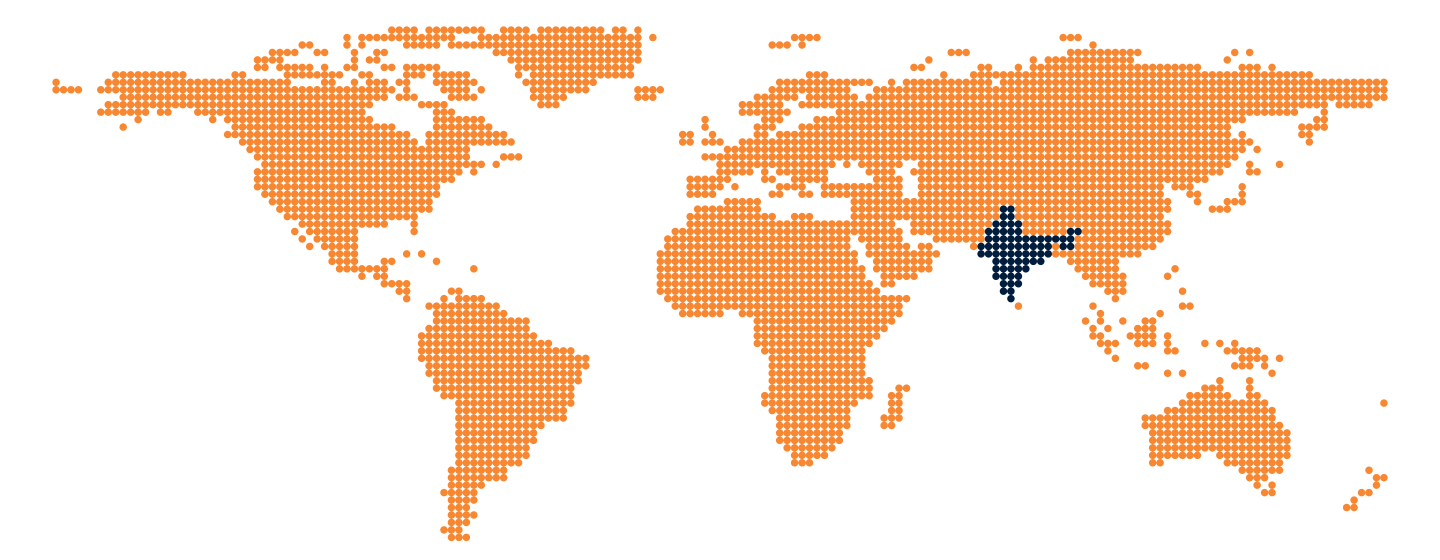
A senior team in San Francisco costs $150–250/hr. A strong team in Eastern Europe runs $50–100/hr. A vetted team in India runs $25–60/hr. The output quality of established development companies at each tier is comparable for most product types: the difference is cost structure, not competence.
Red flags in a quote
Before you sign, check every quote against this list. One flag is worth a question; two or more is worth walking away.
- A fixed price for a complex, new product. Complex software is uncertain. A precise upfront price means a large hidden buffer or a plan to cut scope later.
- No discovery or scoping phase. Without scoping, the estimate is a guess. Good companies price discovery separately or include it explicitly.
- A price far below every other quote. Usually an inexperienced team, hidden quality risk, or scope that will quietly grow after you sign.
- No mention of testing, deployment, or support. These are real costs. If they are missing, you will pay for them later.
- No references or case studies. Ask to speak to a past client with a similar project.
What AI features add to the budget in 2026
AI is now the biggest new line item in software quotes. Adding a chatbot, document processing, or an AI agent to a product changes both the build cost and the running cost, because every model call is billed.
The ranges below are typical published figures for 2026. Treat them as planning brackets, not prices: the real number depends on how much data the feature needs, how many systems it connects to, and how reliable it has to be.
| What you are building | Typical range | What drives the cost |
|---|---|---|
| AI proof of concept | $10,000–$30,000 | One workflow, test data, no production hardening |
| Single-task AI agent or assistant | $15,000–$80,000 | Integrations, guardrails, and evaluation |
| Multi-agent or enterprise AI system | $100,000–$400,000+ | Orchestration, compliance, many connected systems |
| Running costs after launch | 15–25% of build cost per year | Model usage, hosting, monitoring, and maintenance |
How to get an accurate quote for your project
The quality of a quote depends on the quality of the brief. These five steps get you a number you can plan around, and make quotes from different companies comparable.
Describe the problem, not a feature list
Explain what is slow, manual, or costing money today. A good development partner will turn that into the right features; a feature list alone invites guesswork.
Say who will use it and how often
Ten internal users and ten thousand customers need very different architecture, security, and support.
List every system it must connect to
Accounting, CRM, payment gateways, and legacy databases are where hidden cost usually lives.
Ask for phase-based pricing
A priced discovery phase followed by priced build phases gives you cost certainty without locking in guesses.
Compare like with like
Check that each quote includes design, testing, deployment, and post-launch support, not just development hours.
Frequently Asked Questions
Written by
Tricolens
Product & Engineering