

Next.js Sites That Load Fast and Actually Rank
A great interface doesn't matter much if the page loads slowly or never shows up in search. We build Next.js sites and apps with server-side rendering, static generation, and Core Web Vitals performance built in from the start, so SaaS apps, marketing sites, and storefronts load fast and rank where it counts.
Where Next.js Earns Its Place
Next.js is for the projects where performance and search visibility genuinely matter, not every project needs it.
SaaS Web Apps
Fast public pages combined with dynamic, authenticated app experiences in one codebase.
SEO-Critical Marketing Sites
Static generation and server rendering for the crawlability and speed that search visibility depends on.
eCommerce Frontends
Storefronts that load instantly, rank in search, and connect to any commerce backend through APIs.
Customer Portals and Dashboards
Authenticated portals pairing Next.js routing with secure, performant data loading.
Content-Driven Platforms
Publishing and documentation sites using static generation and incremental regeneration for fast, low-maintenance delivery.
Full-Stack Web Apps
API routes alongside the frontend, reducing the overhead of maintaining a separate backend for simpler products.
What We Build With Next.js
We build the range: from SEO-driven marketing sites to authenticated SaaS platforms, shaped by the rendering strategy that fits.
SaaS Web App Development
Server-rendered marketing pages, authenticated app areas, API routes, and database integration, with rendering mapped per route.
SEO-Friendly Site Development
Server-rendered HTML, clean route architecture, and optimized Core Web Vitals for content platforms and marketing sites.
Full-Stack Development
API routes handling backend logic alongside the React frontend, for a simpler, more maintainable single-framework architecture.
Migration and Modernization
Moving existing React SPAs and legacy sites to Next.js for the performance and SEO gains, planned route by route.
How We Build Next.js Apps That Perform
The Next.js advantage only shows up when rendering strategy and performance are handled deliberately.
Rendering Strategy
Each route gets the right rendering method, static, server-rendered, or client-rendered, based on what it actually needs.
- Per-route rendering choice
- ISR for content freshness
- Maintainable route architecture
Core Web Vitals
Image optimization, font strategy, and code splitting applied to hit real performance thresholds, not patched in after launch.
- Image and font optimization
- Code splitting
- LCP, CLS, INP targets
Full-Stack Integration
API routes and data fetching built with TypeScript for end-to-end type safety from database to UI.
- TypeScript end to end
- API routes and server actions
What Runs Around Next.js
Next.js sits at the center, but the rendering host, data layer, and delivery pipeline around it matter just as much.
Frontend
Backend
Database
Delivery
Our Standards for Next.js Projects
A Next.js app built without rendering discipline loses the exact advantages it was chosen for.
Performance Budgets
Core Web Vitals tracked against defined budgets so regressions get caught before release.
Scalable Route and Caching Strategy
Static where possible, dynamic where necessary, cached intelligently so the platform scales without runaway server cost.
Tested and Clean Deployment
Type-safe API logic and CI/CD pipelines so shipping stays low-risk as the platform matures.
Where we've used Next.js
Live projects built with Next.js. Each case study covers what we built and why.
 Client project
Community · Public Safety
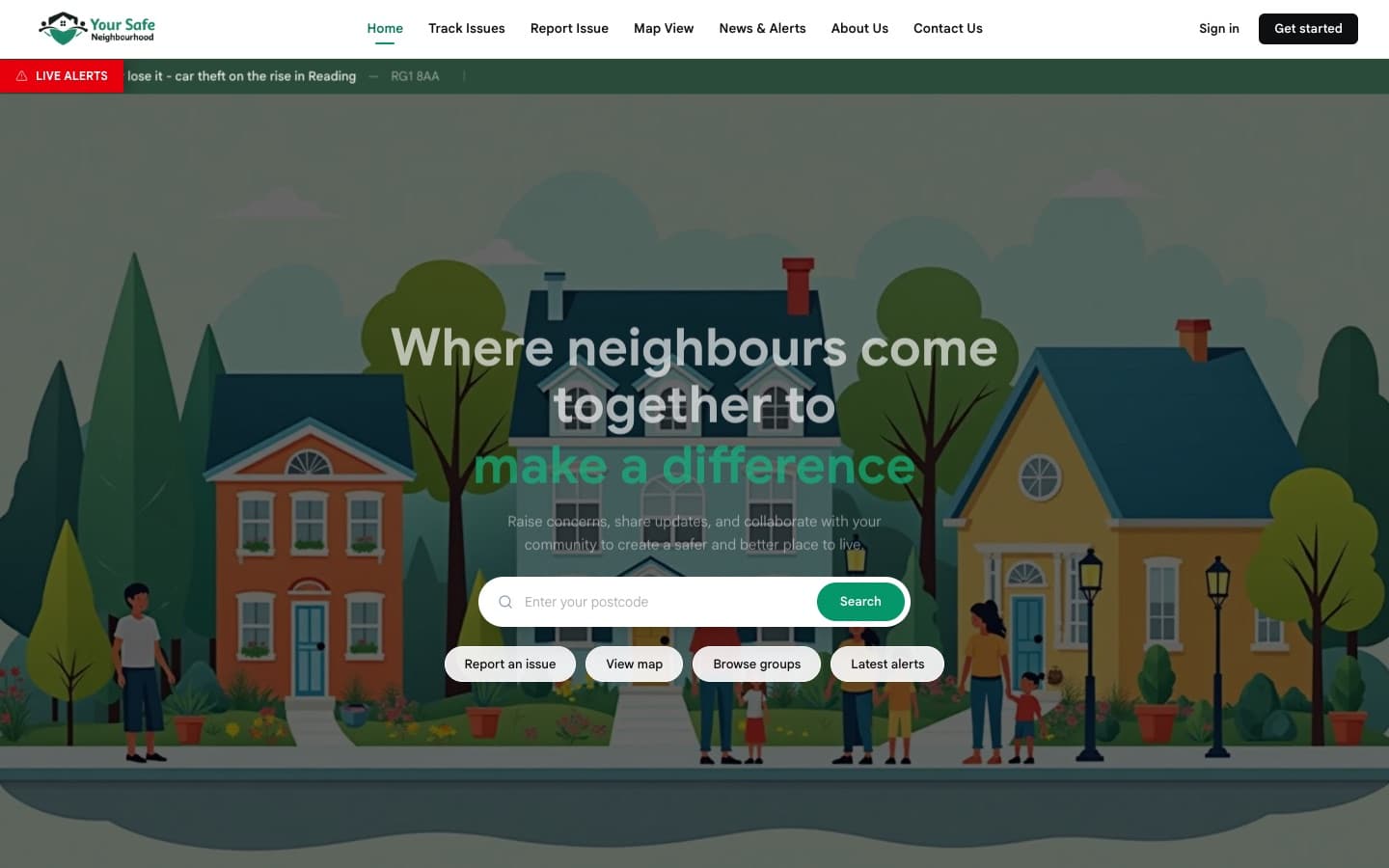
Your Safe Neighbourhood: a free community safety website for UK residents
Read case study Client project
EdTech · Healthcare
Medical Physics Helpdesk: an RSO exam preparation platform
Read case study Client project
Construction · Building Materials
Meet Enterprise: a lead-generating website for an aluminium and glass systems maker
Read case studyFrequently Asked Questions
Common questions about Next.js development.
React is a UI library. Next.js is a full framework built on React adding server-side rendering, static generation, routing, and API routes. We recommend it when a project needs SEO, fast first-load, or full-stack capability React alone doesn't provide.
A standard React app renders content in the browser, which can slow indexing. Next.js renders HTML on the server or at build time so search engines get complete, fast-loading pages.
SaaS web apps, SEO-driven marketing sites, eCommerce frontends, customer portals, dashboards, and full-stack web apps, with rendering strategy chosen per project.
Yes, planned route by route to minimize risk, with rendering strategy assigned based on whether a page is content, dynamic, or authenticated.
As a measurable build target: image optimization, font loading strategy, code splitting, and caching applied to hit LCP, CLS, and INP thresholds.
An SEO-focused marketing site can land in four to eight weeks. SaaS platforms with auth, API routes, and database integration typically take three to five months.
Technologies we pair with Next.js
A Site That Loads Fast and Actually Ranks
SaaS app, marketing site, or storefront, we build Next.js projects with performance engineered in from the first route.